
25 January 2009

22 January 2009
All The Pretty Horses by Cormac McCarthy
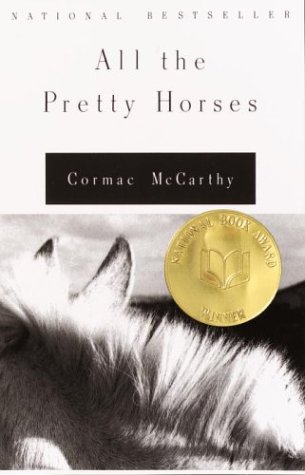 Winner of the National Book Award 1992
"That night he dreamt of horses in a field on a high plain where the spring rains had brought up the grass and the wildflowers out of the ground and the flowers ran all blue and yellow far as the eye could see and in the dream he was among the horses running and in the dream he himself could run with the horses and they coursed the young mares and fillies over the plain where their rich bay and their rich chestnut colors shone in the sun and the young colts ran with their dams and trampled down the flowers in a haze of pollen that hung in the sun like powdered gold and they ran he and the horses out along the high mesas where the ground resounded under their running hooves and they flowed and changed and ran and their manes and tails blew off of them like spume and there was nothing else at all in the high world and they moved all of them in a resonance that was like a music among them and they were none of them afraid horse nor colt nor mare and they ran in that resonance which the world itself and which cannot be spoken but only praised.
In the morning two guards came and opened the door and handcuffed Rawlins and led him away. . . "(161-162).
"He can talk, said the captain. It is better when everybody is understand. You cannot stay here. In this place. You stay here you going to die. Then come other problems. Papers is lost. Peoples cannot be found. Some peoples come here to look for some man but he is not here. No one can find these papers. Something like that. You see. No one wants these troubles. Who can say that some body was here? We dont have this body. Some crazy person, he can say that God is here. But everybody knows that God is no here.
The captain reached out with one hand and rapped with his knuckles against the door.
You didnt have to kill him, said John Grady.
Como?
You could have just brought him back. You could have just brought him on back to the truck.
You didnt have to kill him.
. . .
A man cannot go out to do some thing and then he go back. Why he go back? Because he change his mind? A man does not change his mind.
The captain made a fist and held it up. . . When I come back there is no laughing. No one is laughing. You see. That has always been my way in this world. I am the one when I go someplace then there is no laughing. When I go there then they stop laughing" (180-181).
"The captain stood uncertainly.
Why you come back? he said.
I come back for my horse. Let's go.
The captain nodded at the wound in his leg, still bleeding. The whole trouserleg dark with blood.
You going to die, he said.
We'll let God decide about that. Let's go.
Are you no afraid of God?
I got no reason to be afraid of God. I've even got a bone or two to pick with Him.
You should be afraid of God, the captain said. You are not the officer of the law. You dont have no authority" (272).
14 January 2009
Life, the Universe, and Everything by Douglas Adams
 "He was a man with a purpose. Not a very good purpose, as he would have been the first to admit, but it was at least a purpose, and it did at least keep him on the move.
Wowbagger the Infinitely Prolonged was--indeed, is--one of the Universe's very small number of immortal beings.
Most of those who are born immortal instinctively know how to cope with it, but Wowbagger was not one of them. He had had his immortality inadvertently thrust upon him by an unfortunate accident with an irrational particle accelerator, a liquid lunch and a pair of rubber bands . . . To begin with it was fun; he had a ball, living dangerously, taking risks, cleaning up on high-yield long-term investments, and just generally outliving the hell out of everybody.
In the end, it was the Sunday afternoons he couldn't cope with, and that terrible listlessness that starts to set in at about 2:55, when you know you've taken all the baths you can usefully take that day, that however hard you stare at any given paragraph in the newspaper you will never actually read it, or use the revolutionary new pruning technique it describes, and that as you stare at the clock the hands will move relentlessy on to four o'clock, and you will enter the ong dark teatime of the soul.
So things began to pall for him. The merry smiles he used to wear at other people's funerals began to fade. He began to despise the Universe in general, and everybody in it in particular.
This was the point at which he conceived his purpose, the thing that would drive him on, and which, as far as he could see, would drive him on forever. It was this.
He would insult the Universe.
That is, he would insult everybody in it. Inidividually, personally, one by one, and (this was the thing he really decided to grit his teeth over) in alphabetical order.
When people protested him, as they sometimes had done, that the plan was not merely misguided but actually impossible because of the number of people being born and dying all the time, he would merely fix them with a steely look and say, 'A man can dream, can't he?" (317-318).
09 January 2009
The Restaurant at the End of the Universe by Douglas Adams
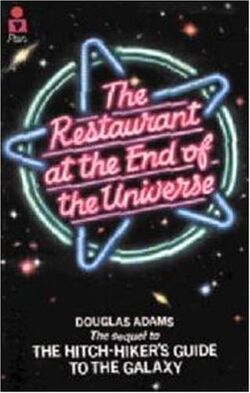 "The Hitchhiker's Guide to the Galaxy notes that Disaster Area, a plutonium rock band from the Gagrakacka Mind Zones, are generally held to be not only the loudest rock band in the Galaxy, but in fact the loudest noise of any kind at all. Regular concert goers judge that the best sound balance is usually to be heard from within large concrete bunkers some thirty-seven miles from the stage, while the musicians themselves play their instruments by remote control from within a heavily insulated spaceship which stays in orbit around the planet--or more frequently around a completely different planet.
Their songs are on the whole very simple and mostly follow the familiar theme of boy-being meets girl-being beneath a silvery moon, which then explodes for no adequately explored reason.
Many worlds have now banned their act altogether, sometimes for artistic reasons, but most commonly because the band's public address system contravenes local strategic arms limitations treaties" (221, Ultimate Hitchhiker's Guide).
"...it is a well-known fact that those people who most want to rule people are, ipso facto, those least suited to do it . . . anyone who is capable of getting themselves made President should on no account be allowed to do the job" (278).
05 January 2009
The Hitchhikers Guide to the Galaxy by Douglas Adams
 "Vogon poetry is of course the third worst in the Universe. The second worst is that of the Azgoths of Kria. During a recitation by their Poet Master Grunthos the Flatulent of his poem "Ode to a Small Lump of Green Putty I Found in My Armpit One Midsummer Morning" four of his audience died of internal hemorrhaging, and the President of the Mid-Galactic Arts Nobbling Council survived by gnawing one of his own legs off. Grunthos is reported to have been "disappointed" by the poem's reception, and was about to embark on a reading of his twelve-book epic entitled My Favorite Bathtime Gurgles when his own major intestine, in a desperate attempt to save life and civilization, leaped straight up through his neck and throttled his brain.
The very worst poetry of all perished along with its creator, Paula Nancy Millstone Jennings of Greenbridge, Essex, England, in the destruction of the planet Earth" (45).
"...on the planet Earth, man had always assumed that he was more intelligent than dolphins because he has achieved so much--the wheel, New York, wars and so on--while all the dolphins had ever done was much about in the water having a good time. But conversely, the dolphins had always believed that they were far more intelligent than man--for precisely the same reasons" (105).
"...at the very moment that Arthur said, 'I seem to be having tremendous difficulty with my life-style,' a freak wormhole opened up in the fabric of the space-time continuum and carried his words far far back in time across infinite reaches of space to a distant galaxy where strange and warlike beings were poised on the brink of frightful interstellar battle.
The two opposing leaders were meeting for the last time . . . and at that very moment the words I seem to be having tremendous difficulty with my life-style drifted across the conference table.
Unfortunately, in the Vl'hurg tongue this was the most dreadful insult imaginable, and there was nothing for it but to wage terrible war for centuries.
Eventually, of course, after their galaxy had been decimated over a few thousand years, it was realized that the whole thing had been a ghastly mistake . . . For thousands more years, the mighty ships tore across the empty wastes of space and finally dived screaming on to the first planet they came across--which happened to be Earth--where due to a terrible miscalculation of scale the entire battle fleet was accidentally swallowed by a small dog" (129).
Subscribe to:
Comments (Atom)


