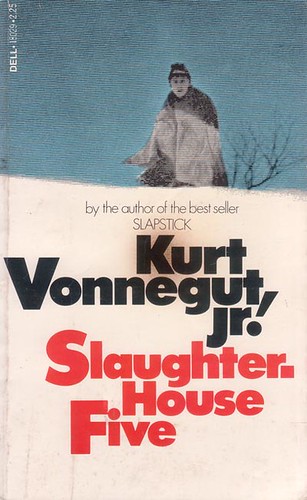
 "'The most important thing I learned on Tralfamadore was that when a person dies he only appears to die. He is still very much alive in the past, so it is very silly for people to cry at his funeral. All moments, past, present, and future, always have existed, always will exist. The Tralfamadorians can look at all the different moments just the way we can look at a stretch of the Rocky Mountains, for instance. They can see how permanent all the moments are, and they can look at any moment that interests them. It is just an illusion we have here on Earth that one moment follows another one, like beads on a string, and that once a moment is gone it is gone forever' " (27).
"Weary was as new to war as Billy. He was a replacement, too. As a part of a gun crew, he had helped to fire one shot in anger--from a 57 millimeter antitank fun. The gun made a ripping sound like the opening of the zipper on the fly of God Almighty. The gun lapped up snow and vegetation with a blowtorch thirty feet long. The flame left a black arrow on the ground, showing the Germans exactly where the gun was hidden. The shot was a miss.
What had been missed was a Tiger tank. It swiveled its 88-millimeter snout around sniffingly, saw the arrow on the ground. It fired. It killed everybody on the gun crew but Weary. So it goes" (35).
"Billy was displayed there in the zoo in a simulated Earthling habitat. Most of the furnishings had been stolen from the Sears Roebuck warehouse in Iowa City, Iowa . . . There were no walls in the dome, no place for Billy to hide. The mint green bathroom fixtures were right out in the open. Billy got off his lounge chair now, went into the bathroom and took a leak. The crowd went wild" (112).


