
10 February 2014

30 July 2012
01 February 2012
30 October 2011
30 August 2011

26 July 2010
Theodore Rex by Edmund Morris

" 'Every man who appreciates the majesty and beauty of the wilderness and of wild life, should strike hands with the far-sighted men who wish to preserve our material resources, in the effort to keep our forests and our game-beasts, game-birds, and game-fish--indeed, all the living creatures of prairie and woodland and seashore--from wanton destruction' " (221).

21 January 2010

25 October 2009

22 September 2009
Resurrection by Leo Tolstoy (Trans.: Rosemary Edmonds)
 "Though men in their hundreds of thousands had tried their hardest to disfigure that little corner of the earth where they had crowded themselves together, paving the ground with stones so that nothing could grow, weeding out every blade of vegetation, filling the air with the fumes of coal and gas, cutting down the trees and driving away every beast and every bird--spring, however, was still spring. . . All were happy--plants, birds, insects and children. But grown-up people--adult men and women--never left off cheating and tormenting themselves and one another. It was not this spring morning which they considered sacred and important, not the beauty of God's world, given to all creatures to enjoy--a beauty which inclines the heart to peace, to harmony and to love. No, what they considered sacred and important were their own devices for wielding power over each other" (19).
"If he had been asked why he considered himself superior to the majority of mankind he would have been unable to find an answer, no facet of his life being distinguished for any particular qualities . . . And yet he was undoubtedly conscious of being superior, and accepted as his due the respect paid to him, and was hurt when he did not get it" (39-40).
"During that summer at his aunt' Nekhlyudov experienced that rapturous state of exaltation when a young man discovers for himself, without any outside recommendation, all the beauty and significance of life, and the importance of the task allotted in life to every man; when he sees the endless perfectibility of himself and the whole universe; and devotes himself not only hopefully but in complete confidence to attaining the perfection he dreams of" (68).
"And all this terrible change had come about simply because he had ceased to put faith in his own conscience and had taken to trusting others. And he had ceased to trust himself and begun to believe in others because life was too difficult if one believed one's own conscience: believing in oneself, every question had to be decided, never to the advantage of one's animal self, which seeks easy gratifications, but in almost every case against it. But to believe in others meant that there was nothing to decide: everything had been decided already, and always in favor of the animal I and against the spirtual. Moreover, when he trusted his own conscience he was always laying himself open to criticism, whereas now, trusting others, he received the approval of those aroung him . . .
. . . and all this time he felt the delight of being liberated from the moral restraint he had formerly accepted for himself, and lived in a continuous mad state of chronic selfishness" (74, 77).
"The distance was so great, the defilement so complete, that at first he despaired of the possibility of being cleansed. 'Haven't you tried before to improve and be better, and nothing came of it?' whispered the voice of the tempter within. 'So what is the use of trying any more? You are not the only one--everyone's the same--life is like that,' whispered the voice. . . . However vast the disparity between what he was and what he wished to be, everything appeared possible to this newly awakened spiritual being . . .
He prayed, asking God to help him, to enter into him and cleanse him . . . He felt himself one with Him, and therefore was conscious not only of the freedom, the courage and joy of life, but of all the power of righteousness. All, all the best a man could do, he now felt himself capable of doing . . .
Nekhyludov gazed at the moonlit garden, the roof and the shadow of the poplar, and drank in the fresh invigorating air.
'How good, how good, O Lord, how good!' he said of what was in his soul" (141-3).
"He was not guilty of an evil act, but there was something far worse than an evil action: there were thoughts which give birth to bad deeds. An evil act need not be repeated and can be repented of, but evil thoughts engender evil acts. A bad act only smoothes the path for other bad acts, whereas evil thoughts drag one irresistibly along the path" (374-5).
"'The animal nature of man is abominable,' he thought, 'but so long as it remains undisguised you can look down on it from the heights of your spiritual life and despise it, and whether you succumb or resist, you remain what you were before; but when this animality is concealed under a pseudoaesthetic, poetic veil and demands adulation--then in worshipping the animal you become engulfed in it and can no longer distinguish good from evil. Then it is awful' "(391).
"Then he used to devise things to do, which always centered round one and the same person--Dmitri Ivanovich Nekhyudov; and yet, notwithstanding the fact that all the interests of life had Dmitri Ivanovich as their pivot he was bored with all of them. Now everything he did concerned other people, and not Dmitri Ivanovich, and they were all interesting and absorbing, and there was no end to them . . . the affairs of Dmitri Ivanovich always made him feel peevish and irritable; whereas now being busy for other people generally put him in a happy frame of mind" (399).
16 September 2009

The Death and Life of Great American Cities by Jane Jacobs (to p. 208)

"There is a wistful myth that if only we had enough money to spend. . .we could wipe out all our slums in ten years, reverse decay in the great, dull, gray belts that were yesterday's and day-before-yesterday's suburbs, anchor the wandering middle class and its wandering tax money, and perhaps even solve the traffic problem.
But look what we have built with the first several billions:
Low-income projects that become worse centers of delinquency, vandalism and general social hopelessness than the slums they were supposed to replace. Middle-income housing projects which are truly marvels of dullness and regimentation, sealed against any buoyancy or vitality of city life. . .Cultural centers that are unable to support a good bookstore. Civic centers that are avoided by everyone but bums, who have fewer choices of loitering places than others. . .This is not the rebuilding of cities. This is the sacking of cities" (p. 4).
"Automobiles are often conveniently tagged as the villains responsible for the ills of cities and the disappointments and futilities of city planning. But the destructive effects of automobiles are much less a cause than a symptom of our incompetence at city building. . ." (p. 7).
"In New York's East Harlem there is a housing project with a conspicuous rectangular lawn which became an object of hatred to the project tenants. . .Finally one day a tenant more articulate than the others made this pronouncement: 'Nobody cared what we wanted when they built this place. They threw our houses down and pushed us here and pushed our friends somewhere else. We don't have a place around here to get a cup of coffee or a newspaper even, or borrow fifty cents. Nobody cared what we need. But the big men come and look at that grass and say, 'Isn't it wonderful! Now the poor have everything!' ' . . . There is a quality even meaner than outright ugliness or disorder, and this meaner quality is the dishonest mask of pretended order, achieved by ignoring or suppressing the real order that is struggling to exist and to be served" (p. 15).
"Towns, suburbs and even little cities are totally different organisms from great cities. We are in enough trouble already from trying to understand big cities in terms of the behavior, and the imagined behavior, of towns. To try to understand towns in terms of big cities will only compound the confusion" (p. 16).
"His aim was the creation of self-sufficient small towns, really very nice towns if you were docile and had no plans of your own and did not mind spending your life among others with no plans of their own. As in all Utopias, the right to have plans of any significance belonged only to the planners in charge" (p. 17).
Ebenezer Howard's Garden City
"Howard set spinning powerful and city-destroying ideas: He conceived that the way to deal with the city's functions was to sort and sift out of the whole certain simple uses, and to arrange each of these in relative self-containment" (p. 18).
Euclidean Zoning a "city-destroying" idea?
"But unless eyes are there, and unless in the brains behind those eyes is the almost unconscious reassurance of general street support in upholding civilization, lights can do no good. Horrifying public crimes can, and do, occur in well-lighted subway stations when no effective eyes are present. They virtually never occur in darkened theaters where many people and eyes are present. Street lights can be like that famous stone that falls in the desert where there are no ears to hear. Does it make a noise? Without effective eyes to see, does a light cast light? Not for practical purposes" (p. 43).
"As children get older, this incidental outdoor activity. . .becomes less bumptious physically and entails more loitering with others, sizing people up, flirting, talking, pushing, shoving and horseplay. Adolescents are always being criticized for this kind of loitering, but they can hardly grow up without it. The trouble comes when it is done not within society, but as a form of outlaw life" (p. 86).
"Some city sidewalks are undoubtedly evil places for rearing children. They are evil for anybody. . .In defective neighborhoods, shooing the children into parks and playgrounds is worse than useless, either as a solution to the streets' problems or as a solution for the children" (p. 87).
"In orthodox city planning, neighborhood open spaces are venerated in an amazingly uncritical fashion, much as savages venerate magical fetishes. Ask a houser how his planned neighborhood improves on the old city and he will cite, as a self-evident virtue, More Open Space. Ask a zoner about the improvements in progressive codes and he will cite, again as a self-evident virtue, their incentives toward leaving More Open Space. Walk with a planner through a dispirited neighborhood and though it be already scabby with deserted parks and tired landscaping festooned with old Kleenex, he will envision a future of More Open Space.
More Open Space for what? For muggings? For bleak vacuums between buildings? Or for ordinary people to use and enjoy? But people do not use city open space just because it is there and because city planners or designers wish they would" (p. 90).
"Los Angeles, which needs lung help more than any other American city, also happens to have more open space than any other large city; its smog is partly owing to local eccentricities of circulation in the ocean of air, but also partly to the city's very scatter and amplitude of open space itself" (p.91).
"Philadelphia's Washington Square--the one that became a pervert park. . .Its rim is dominated by huge office buildings, and both this rim and its immediate hinterland lack any equivalent to the diversity of Rittenhouse Square--services, restaurants, cultural facilities. . .[it has] only one significant reservoir of potential users: the office workers. . .They all enter the district at once. They are then incarcerated all morning until lunch, and incarcerated again after lunch. They are absent after working hours. Therefore, Washington Square, of necessity, is a vacuum most of the day and evening. Into it came what usually fills city vacuums--a form of blight. . .
Far in the past, Washington Square did have a good population of users. But although it is still the 'same' park, its use and essence changed completely when its surroundings changed. Like all neighborhood parks, it is the creature of its surroundings and of the way its surroundings generate mutual support from diverse uses, or fail to generate such support.
It need not have been office work that depopulated this park. Any single, overwhelmingly dominate use imposing a limited schedule of users would have had a similar effect" (p. 97, 98).
"In cities, liveliness and variety attract more liveliness; deadness and monotony repel life. And this is a principle vital not only to the way cities behave socially, but also to the ways they behave economically.
There is however, one important exception to the rule that it takes a wide functional mixture of users to populate and enliven a neighborhood park through the day. There is one group in cities which, all by itself, can enjoy and populate a park long and well--although it seldom draws other types of users. This is the group of people with total leisure, the people who lack even the responsibilities of home. . .these are the people of. . .the Skid Row park" (p. 99).
" (p. 99).
"But there is no point in bringing parks to where people are, if in the process the reasons that the people are there are wiped out and the park substituted for them" (p. 101).
08 September 2009
1776 by David McCullough
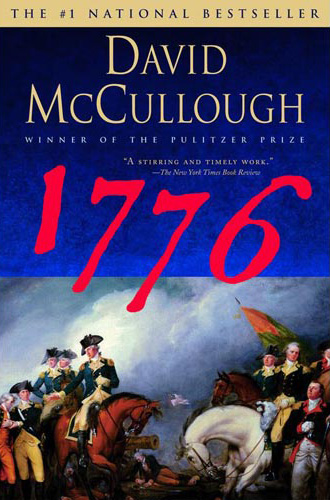 "Though nearly morning, a large part of the army still waited to embark, and without the curtain of night to conceal them, their escape was doomed.
Incredibly, yet again, circumstances--fate, luck, Providence, the hand of God, as would be said so often--intervened.
Just at daybreak a heavy fog settled in over the whole of Brooklyn, concealing everything no less that had the night. It was fog so thick, remembered one soldier, that one 'could scarcely discern a man at six yards distance.' Even with the sun up, the for remained as dense as ever, while over on the New York side of the river there was no fog at all . . .
In a single night, 9,000 troops had escaped across the river" (190-191).
Joseph Reed: "'When I look round, and see how few of the numbers who talked so largely of death and honor are around me, and that those who are here are those from whom it was least expected . . . I am lost in wonder and surprise. . . . Your noisy sons of liberty are, I find, the quietest in the field. . . . An engagement, or even the expectation of one, gives a wonderful insight into character" (204-205).
"The year 1776 . . . was for those who carried the fight for independence forward a year of all-too-few victories, of sustained suffering, disease, hunger, desertion, cowardice, disillusionment, defeat, terrible discouragement, and fear, as they would never forget, but also of phenomenal courage and bedrock devotion to country, and that, too, they would never forget.
Especially for those who had been with Washington and who knew what a close call it was at the beginning--how often circumstance, storms, contrary winds, the oddities or strengths of individual character had made the difference--the outcome seemed little short of a miracle" (294).
26 August 2009
The True Story of Hansel and Gretel by Louise Murphy

"'God shouldn't have let this killing happen. God should have stopped it.'
Starzec gestured at the trees and the forest around them. 'Do you see God? Where is he, you fool?'
Dobry flushed and shook his head. 'I don't know.'
'God didn't come down and kill us. I don't see God shooting children and priests. None of us met God beating up Jews and shoving them into railroad cars. This is men doing the murdering. Talk to men about their evil, kill the evil men, but pray to God. You can't expect God to come down and do our living for us. We have to do that ourselves'" (207).
11 August 2009
Harry Potter Series by J K Rowling
(Haven't had a lot of time to read for quite a while with school and work and everything keeping me very busy.)
I started listening to the books on mp3 while I was working to keep me entertained. The books got better and better and I started checking them out and reading them while I wasn't at work. I got so glued to them that I read the last two books within a few days. I have to agree with those that say the books are better than the movies. There is so much left out in the movies and they seem so choppy after reading the books!
My one annoyance with the books is how Harry Potter is always so quick to get angry and bitter. The boy has some issues.
I started listening to the books on mp3 while I was working to keep me entertained. The books got better and better and I started checking them out and reading them while I wasn't at work. I got so glued to them that I read the last two books within a few days. I have to agree with those that say the books are better than the movies. There is so much left out in the movies and they seem so choppy after reading the books!
My one annoyance with the books is how Harry Potter is always so quick to get angry and bitter. The boy has some issues.
07 May 2009
The Crossing by Cormac McCarthy
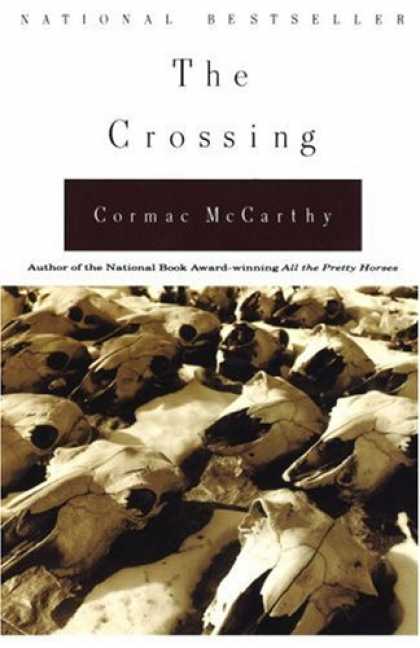
"All my life, he said, I been witness to people showin up where they was supposed to be at various times after they'd said they'd be there. I never heard one yet that didnt have a reason for it.
Yessir.
But there aint but one reason.
Yessir.
You know what it is?
No sir.
It's that their word's no good. That's the only reason there ever was or ever will be.
Yessir" (p. 51).
"He said that while one would like to say that God will punish those who do such things and that people often speak in just this way it was his experience that God could not be spoken for and that men with wicked histories often enjoyed lives of comfort and that they died in peace and were buried with honor. He said that it was a mistake to expect too much of justice in this world. He said that the notion that evil is seldom rewarded was greatly overspoken for if there were no advantage to it then men would shun it and how could virtue then be attached to its repudiation? It was the nature of his profession that his experience with death should be greater than for most and he said that while it was true that time heals bereavement it does so only at the cost of the slow extinction of those loved ones from the heart's memory which is the sole place of their abode then or now. Faces fade, voices dim. Seize them back, whispered the sepulturero. Speak with them. Call their names. Do this and do not let sorrow die for it is the sweetening of every gift" (p. 288).
"From a certain perspective one might even hazard to say that the great trouble with the world was that that which survived was held in hard evidence as to past events. A false authority clung to what persisted, as if those artifacts of the past which had endured had done so by some act of their own will. Yet the witness could not survive the witnessing. In the world that came to be that which prevailed could never speak for that which perished but could only parade its own arrogance. It pretended symbol and summation of the vanished world but was neither" (p. 410-11).
03 April 2009

27 March 2009
Into the Wild by Jon Krakauer
 "The climbing was steep and so exposed it made my head spin. Beneath my Vibram soles the wall fell away for three thousand feet . . . Above, the prow soared with authority toward the summit ridge, a vertical half mile above. Each time I planted one of my ice axes, that distance shrank by another twenty inches. All that held me to the mountainside, all that held me to the world, were two thin spikes of chrome molybdenum stuck half an inch into a smear of frozen water . . . Early on a difficult climb, especially a difficult solo climb, you constantly feel the abyss pulling at your back. To resist takes tremendous conscious effort; you don't dare let your guard down for an instant. The siren song of the void puts you on edge; it makes your movements tentative, clumsy, herky-jerky. But as the climb goes on you grouw accustomed to the exposure, you get used to rubbing shoulders with doom, you come to believe in the reliability of your hands and feet and head. You learn to trust your self-control. By and by your attention becomes so intensely focused that you no longer notice the raw knuckles, the cramping thighs, the strain of maintaining nonstop concentration. A trancelike state settles over your efforts; the climb becomes a clear-eyed dream. Hours slide by like minutes. The accumulated clutter of day-to-day existence--the lapses of conscience, the unpaid bills, the bungled opportunities, the dust under the couch, the inescapable prison of your genes--all of it is temporarily forgotten, crowded from your thoughts by an overpowering clarity of purpose and by the seriousness of the task at hand" (p.142-3).
"It is easy, when you are young, to believe that what you desire is no less than what you deserve, to assume that if you want something badly enough, it is your God-given right to have it. When I decided to go to Alaska that April, like Chris McCandless, I was a raw youth who mistook passion for insight and acted according to an obscure, gap-ridden logic. I thought climbing the Devils Thumb would fix all that was wrong with my life. In the end, of course, it changed almost nothing. But I came to appreciate that mountains make poor receptacles for dreams. And I lived to tell my tale" (155).
"'Wilderness appealed to those bored or disgusted with man and his works. It not only offered an escape from society but also was an ideal stage for the Romantic individual to exercise the cult that he frequently made of his own soul. The solitude and total freedom of the wilderness created a perfect setting for either melancholy or exultation.' - Roderick Nash, Wilderness and The American Mind" (157).
24 March 2009

22 March 2009
The Rise of Theodore Roosevelt by Edmund Morris
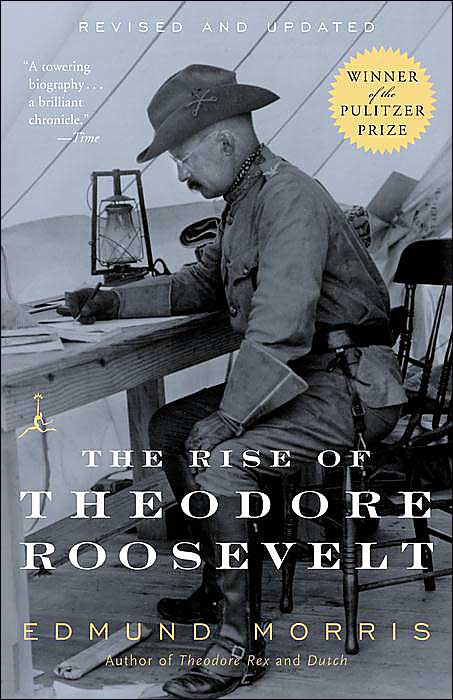 "On winter evenings in Rock Creek Park, strollers may observe the President of the United States wading pale and naked into the ice-clogged stream . . . Thumping noises in the White House library indicate that Roosevelt is being thrown around the room by a Japanese wrestler; a particularly seismic crash, which makes the entire mansion tremble, signifies that Secretary Taft has been forced to join in the fun" (xxii).
"Although he hardly ever swears--his intolerance of bad language verges on the prissy--he can pack such venom into a word like "swine" that it has the force of an obscenity . . . Old timers still talk about the New York Supreme Court Justice he pilloried as 'an amiable old fuzzy-wuzzy with sweetbread brains.' Critics of the Administration's Panama policy are 'a small bunch of shrill eunuchs' . . . President Castro of Venezuela is 'an unspeakably villainous little monkey' . . . When delivering himself of such insults, the President grimaces with glee" (xxviii).
"He will continue to read in the light of a student lamp, peering through his one good eye (the other is almost blind) at the book held inches from his nose, flicking over pages at a rate of two or three a minute. This is the time of the day he loves best. 'Reading with me is a disease.' . . . Asked to summarize the book he has been leafing through with such apparent haste, he will do so in minute detail, often quoting the actual text. The President manages to get through at least one book a day even when he is busy" (xxxii-xxxiii).
"'I heard one or two shots in the bar-room as I came up, and I disliked going in. But there was nowhere else to go, and it was a cold night. Inside the room were several men, who, including the bartender, were wearing the kind of smile worn by men who are making believe to like what they don't like. A shabby individual in a broad hat with a cocked gun in each hand was walking up and down the floor talking with strident profanity. He had evidently been shooting at the clock, which had two or three holes in its face . . . As soon as he saw me he hailed me as "Four Eyes", in reference to my spectacles, and said, "Four Eyes is going to treat." I joined in the laugh and got behind the stove and sat down, thinking to escape notice. He followed me, however, and though I tried to pass it off as a jest this merely made him more offensive, and he stood leaning over me, a gun in each hand, using very foul language . . . In response to his reiterated command that I should set up the drinks, I said, "Well, if I've got to, I've got to," and rose, looking past him. As I rose, I struck quick and hard with my right just to one side of the point of his jaw, hitting with my left as I straightened out, and then again with my right. He fired the guns, but I do not know whether this was merely a convulsive action of his hands, or whether he was trying to shoot at me. When he went down he struck the corner of the bar with his head . . . if he had moved I was about to drop on my knees; but he was senseless. I took away his guns, and the other people in the room, who were now loud in their denunciations of him, hustled him out and put him in the shed.' Next morning Roosevelt heard to his satisfaction that the bully had left town on a freight train" (275-6).
06 March 2009
Greek & Roman Literature (from Mythology course)
- Hesiod's Theogony
- Ovid's Metamorphoses
- Homer's Odyssey
- The Homeric Hymns
- The Library of Apollodorus
- Apollonius' Argonautica
- Livy's History of Rome
- Vergil's Aeneid
- Aeschylus'-Agamemnon, The Eumenides, Prometheus Bound;
- Sophocles'- Oedipus The King, Antigone;
- Euripides'- The Bacchae, Alcestis, Hippolytus
09 February 2009

04 February 2009
The Audacity of Hope by Barack Obama
 "...each successive year will make you more intimately acquainted with all of your flaws . . . In me, one of those flaws had proven to be a chronic restlessness; an inability to appreciate, no matter how well things were going, those blessings that were right there in front of me. It's a flaw that is endemic to modern life, I think--endemic, too, in the American character--and one that is nowhere more evident than in the field of politics" (2-3).
"...over the long haul, I think we make a mistake when we fail to acknowledge the power of faith in the lives of the American people, and so avoid joining a serious debate about how to reconcile faith with our modern, pluralistic democracy" (214).
"Moreover, nothing is more transparent than inauthentic expressions of faith--such as the politician who shows up at a black church around election time and claps (off rhythm) to the gospel choir or sprinkles in a few biblical citations to spice up a thoroughly dry policy speech" (215-216).
"To say that men and women should not inject their 'personal morality' into public-policy debates is a practical absurdity; our law is by definition a codification of morality, much of it grounded in the Judeo-Christian tradition.
What our deliberative, pluralistic democracy does demand is that the religiously motivated translate their concerns into universal, rather than religion-specific, values" (218-219).
"We should also acknowledge that conservatives--and Bill Clinton--were right about welfare as it was previously structured: By detaching income from work, and by making no demands on welfare recipients other than a tolerance for intrusive bureaucracy and an assurance that no man lived in the same house as the mother as his children, the old AFDC program sapped people of their initiative and eroded their self-respect. Any strategy to reduce intergenerational poverty has to be centered on work, not welfare--not only because work provides independence and income but also because work provides order, structure, dignity, and opportunities for growth in people's lives..." (256).
"What would that be worth to all of us--an America in which crime has fallen, more children are cared for, cities are reborn, and the biases, fear, and discord that black poverty feeds are slowly drained away? Would it be worth what we've spent in the past year in Iraq? Would it be worth relinquishing demands for estate tax repeal? It's hard to quantify the benefits of such changes--precisely because the benefits would be immeasurable" (259).
"Moreover, while America's revolutionary origins and republican form of government might make it sympathetic toward those seeking freedom elsewhere, America's early leaders cautioned against idealistic attempts to export our way of life; according to John Quincy Adams, America should not go 'abroad in search of monsters to destroy' nor 'become the dictatress of the world.' Providence had charged America with the task of making a new world, not reforming the old..." (280).
"That was the best of the American spirit, I thought--having the audacity to believe despite all the evidence to the contrary that we could restore a sense of community to a nation torn by conflict; the gall to believe that despite personal setbacks, the loss of a job or an illness in the family or a childhood mired in poverty, we had some control--and therefore responsibility--over our own fate" (356).
25 January 2009

22 January 2009
All The Pretty Horses by Cormac McCarthy
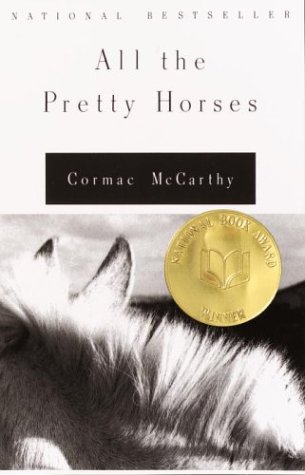 Winner of the National Book Award 1992
"That night he dreamt of horses in a field on a high plain where the spring rains had brought up the grass and the wildflowers out of the ground and the flowers ran all blue and yellow far as the eye could see and in the dream he was among the horses running and in the dream he himself could run with the horses and they coursed the young mares and fillies over the plain where their rich bay and their rich chestnut colors shone in the sun and the young colts ran with their dams and trampled down the flowers in a haze of pollen that hung in the sun like powdered gold and they ran he and the horses out along the high mesas where the ground resounded under their running hooves and they flowed and changed and ran and their manes and tails blew off of them like spume and there was nothing else at all in the high world and they moved all of them in a resonance that was like a music among them and they were none of them afraid horse nor colt nor mare and they ran in that resonance which the world itself and which cannot be spoken but only praised.
In the morning two guards came and opened the door and handcuffed Rawlins and led him away. . . "(161-162).
"He can talk, said the captain. It is better when everybody is understand. You cannot stay here. In this place. You stay here you going to die. Then come other problems. Papers is lost. Peoples cannot be found. Some peoples come here to look for some man but he is not here. No one can find these papers. Something like that. You see. No one wants these troubles. Who can say that some body was here? We dont have this body. Some crazy person, he can say that God is here. But everybody knows that God is no here.
The captain reached out with one hand and rapped with his knuckles against the door.
You didnt have to kill him, said John Grady.
Como?
You could have just brought him back. You could have just brought him on back to the truck.
You didnt have to kill him.
. . .
A man cannot go out to do some thing and then he go back. Why he go back? Because he change his mind? A man does not change his mind.
The captain made a fist and held it up. . . When I come back there is no laughing. No one is laughing. You see. That has always been my way in this world. I am the one when I go someplace then there is no laughing. When I go there then they stop laughing" (180-181).
"The captain stood uncertainly.
Why you come back? he said.
I come back for my horse. Let's go.
The captain nodded at the wound in his leg, still bleeding. The whole trouserleg dark with blood.
You going to die, he said.
We'll let God decide about that. Let's go.
Are you no afraid of God?
I got no reason to be afraid of God. I've even got a bone or two to pick with Him.
You should be afraid of God, the captain said. You are not the officer of the law. You dont have no authority" (272).
14 January 2009
Life, the Universe, and Everything by Douglas Adams
 "He was a man with a purpose. Not a very good purpose, as he would have been the first to admit, but it was at least a purpose, and it did at least keep him on the move.
Wowbagger the Infinitely Prolonged was--indeed, is--one of the Universe's very small number of immortal beings.
Most of those who are born immortal instinctively know how to cope with it, but Wowbagger was not one of them. He had had his immortality inadvertently thrust upon him by an unfortunate accident with an irrational particle accelerator, a liquid lunch and a pair of rubber bands . . . To begin with it was fun; he had a ball, living dangerously, taking risks, cleaning up on high-yield long-term investments, and just generally outliving the hell out of everybody.
In the end, it was the Sunday afternoons he couldn't cope with, and that terrible listlessness that starts to set in at about 2:55, when you know you've taken all the baths you can usefully take that day, that however hard you stare at any given paragraph in the newspaper you will never actually read it, or use the revolutionary new pruning technique it describes, and that as you stare at the clock the hands will move relentlessy on to four o'clock, and you will enter the ong dark teatime of the soul.
So things began to pall for him. The merry smiles he used to wear at other people's funerals began to fade. He began to despise the Universe in general, and everybody in it in particular.
This was the point at which he conceived his purpose, the thing that would drive him on, and which, as far as he could see, would drive him on forever. It was this.
He would insult the Universe.
That is, he would insult everybody in it. Inidividually, personally, one by one, and (this was the thing he really decided to grit his teeth over) in alphabetical order.
When people protested him, as they sometimes had done, that the plan was not merely misguided but actually impossible because of the number of people being born and dying all the time, he would merely fix them with a steely look and say, 'A man can dream, can't he?" (317-318).
09 January 2009
The Restaurant at the End of the Universe by Douglas Adams
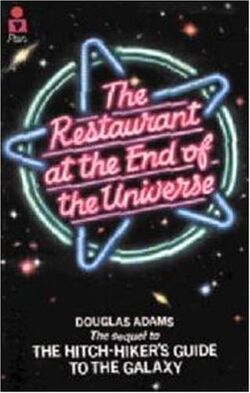 "The Hitchhiker's Guide to the Galaxy notes that Disaster Area, a plutonium rock band from the Gagrakacka Mind Zones, are generally held to be not only the loudest rock band in the Galaxy, but in fact the loudest noise of any kind at all. Regular concert goers judge that the best sound balance is usually to be heard from within large concrete bunkers some thirty-seven miles from the stage, while the musicians themselves play their instruments by remote control from within a heavily insulated spaceship which stays in orbit around the planet--or more frequently around a completely different planet.
Their songs are on the whole very simple and mostly follow the familiar theme of boy-being meets girl-being beneath a silvery moon, which then explodes for no adequately explored reason.
Many worlds have now banned their act altogether, sometimes for artistic reasons, but most commonly because the band's public address system contravenes local strategic arms limitations treaties" (221, Ultimate Hitchhiker's Guide).
"...it is a well-known fact that those people who most want to rule people are, ipso facto, those least suited to do it . . . anyone who is capable of getting themselves made President should on no account be allowed to do the job" (278).
05 January 2009
The Hitchhikers Guide to the Galaxy by Douglas Adams
 "Vogon poetry is of course the third worst in the Universe. The second worst is that of the Azgoths of Kria. During a recitation by their Poet Master Grunthos the Flatulent of his poem "Ode to a Small Lump of Green Putty I Found in My Armpit One Midsummer Morning" four of his audience died of internal hemorrhaging, and the President of the Mid-Galactic Arts Nobbling Council survived by gnawing one of his own legs off. Grunthos is reported to have been "disappointed" by the poem's reception, and was about to embark on a reading of his twelve-book epic entitled My Favorite Bathtime Gurgles when his own major intestine, in a desperate attempt to save life and civilization, leaped straight up through his neck and throttled his brain.
The very worst poetry of all perished along with its creator, Paula Nancy Millstone Jennings of Greenbridge, Essex, England, in the destruction of the planet Earth" (45).
"...on the planet Earth, man had always assumed that he was more intelligent than dolphins because he has achieved so much--the wheel, New York, wars and so on--while all the dolphins had ever done was much about in the water having a good time. But conversely, the dolphins had always believed that they were far more intelligent than man--for precisely the same reasons" (105).
"...at the very moment that Arthur said, 'I seem to be having tremendous difficulty with my life-style,' a freak wormhole opened up in the fabric of the space-time continuum and carried his words far far back in time across infinite reaches of space to a distant galaxy where strange and warlike beings were poised on the brink of frightful interstellar battle.
The two opposing leaders were meeting for the last time . . . and at that very moment the words I seem to be having tremendous difficulty with my life-style drifted across the conference table.
Unfortunately, in the Vl'hurg tongue this was the most dreadful insult imaginable, and there was nothing for it but to wage terrible war for centuries.
Eventually, of course, after their galaxy had been decimated over a few thousand years, it was realized that the whole thing had been a ghastly mistake . . . For thousands more years, the mighty ships tore across the empty wastes of space and finally dived screaming on to the first planet they came across--which happened to be Earth--where due to a terrible miscalculation of scale the entire battle fleet was accidentally swallowed by a small dog" (129).
29 December 2008
Slaughterhouse-Five by Kurt Vonnegut
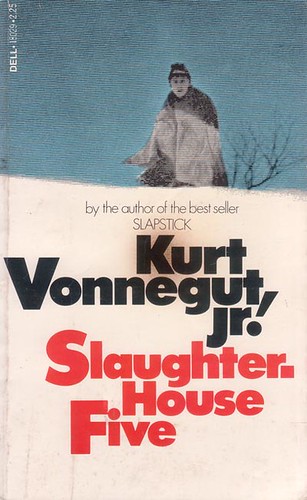 "'The most important thing I learned on Tralfamadore was that when a person dies he only appears to die. He is still very much alive in the past, so it is very silly for people to cry at his funeral. All moments, past, present, and future, always have existed, always will exist. The Tralfamadorians can look at all the different moments just the way we can look at a stretch of the Rocky Mountains, for instance. They can see how permanent all the moments are, and they can look at any moment that interests them. It is just an illusion we have here on Earth that one moment follows another one, like beads on a string, and that once a moment is gone it is gone forever' " (27).
"Weary was as new to war as Billy. He was a replacement, too. As a part of a gun crew, he had helped to fire one shot in anger--from a 57 millimeter antitank fun. The gun made a ripping sound like the opening of the zipper on the fly of God Almighty. The gun lapped up snow and vegetation with a blowtorch thirty feet long. The flame left a black arrow on the ground, showing the Germans exactly where the gun was hidden. The shot was a miss.
What had been missed was a Tiger tank. It swiveled its 88-millimeter snout around sniffingly, saw the arrow on the ground. It fired. It killed everybody on the gun crew but Weary. So it goes" (35).
"Billy was displayed there in the zoo in a simulated Earthling habitat. Most of the furnishings had been stolen from the Sears Roebuck warehouse in Iowa City, Iowa . . . There were no walls in the dome, no place for Billy to hide. The mint green bathroom fixtures were right out in the open. Billy got off his lounge chair now, went into the bathroom and took a leak. The crowd went wild" (112).

Subscribe to:
Comments (Atom)


